
Fastest Delivery and Low MOQ Development with Money Back Guarantee...
(213)-426-1030
info@customrubbersiliconemolds.com
Fastest Delivery and Low MOQ Development with Money Back Guarantee...

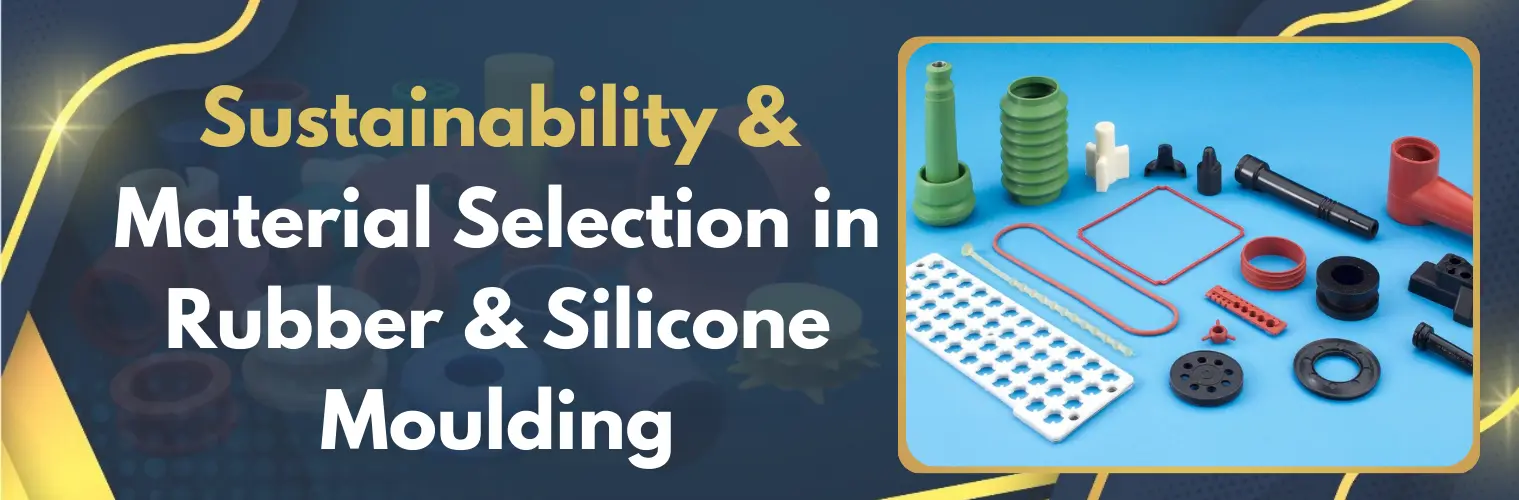
In the current-day manufacturing, sustainability is now the primary concern, and the elastomer business is not an exception as rubber and silicone moulding are being transformed drastically.
With the growing number of industries in the automotive sector, medical sector, consumer goods sector, and industrial sector adopting eco-friendly operations and procedures, the choice of the appropriate material is no longer a purely performance-based decision.
Now it is about considering environmental consideration, recyclability, life cycle performance, and resource usage. The previously versatile and durable rubber and silicone moulding cannot afford to ignore the worldwide demand of more sustainable materials and sustainable production.
This blog discusses the role of sustainability in material selection and the way through which project engineers could incorporate sustainability in balancing between performance and environmental stewardship.
Each elastomer, such as natural rubber, synthetic rubber, and silicone, has its own environmental footprint, which starts its process with sourcing of the raw materials, proceeds through the manufacturing stage, product usage, and disposal. Historically, the elastomers have been selected exclusively on the basis of their working characteristics, namely, the flexing quality, heat resistant, chemical compatibility and durability.
However, the contemporary industry also looks at the impact of the material to the environment in the life cycle as a whole.
An example of the naturally occurring material that is biodegradable is natural rubber which is made up of renewable tree sap (latex). But it is either deforestation or monoculture farming unless the natural rubber is responsibly sourced. Synthetic rubbers such as EPDM, NBR, and SBR are on the other hand petroleum-based, which have higher carbon footprint, but have better chemical resistance and performance at extreme conditions.
Silicone is in a unique category of the sustainability spectrum, as it is made of silica (sand), which is one of the most abundant natural resources, but it takes a lot of energy to process.
Sustainability of an elastomer is not a single factor. The factor of durability is significant: the longer the life of materials, the fewer are replaced, the fewer wastes are produced, and the less impact on nature.
Moreover, the development of compounding, curing, and molding technologies also assist with the increase of energy efficiency and minimize emissions during the process. The initial step towards making responsible material decisions is to understand these trade-offs.
The Molding projects done nowadays are a balance between sustainability and performance through the choice of materials. Natural rubber is considered one of the most friendly-to-the-environment elastomers since it is a biodegradable material, is a renewable material, and has moderate temperature performance, which makes it perfect in use where there is need to have flexibility, strength, and moderate temperature.
The natural rubber can however not be used in extreme heat, chemical exposure and UV radiation environments because it might not perform well in such environments.
Silicone does not degrade, but is very strong and very stable. It is resistant to extreme temperatures, UV rays, weathering, and chemicals hence it may be used in medical instruments, automobile parts, household products, and food grade products.
Silicone has a long life cycle that compensates the high first environmental cost. Also, more platinum-cured, low-VOC and recyclable silicone formulations in the industry are emerging, and thus, the industry attempts to mitigate ecological impact.
Synthetic elastomers, like EPDM, NBR, FKM (Viton), and neoprene, have unsurpassed performance in sealing, chemical resistance and fluid compatibility. Although these materials are not traditionally as sustainable as they rely on petrochemicals, there are new innovations in bio-based synthetic rubbers that alter the situation.
Examples include bio-EPDM and natural-oil-extended SBR that save the use of fossil fuel and encourage use of low carbon processing.
Recycled rubber, which used to only find its place in the low-grade category is now being considered as a raw material in high-end custom moulding due to improved mechanical reprocessing methods.
Devulcanized rubber-rubber which has been subjected to a process which has allowed its crosslinks to be broken and which has allowed it to become processable- again- opens new opportunities to waste streams reduction, without compromising its functional performance.
Design optimization is a critical factor in the field of rubber and silicone moulding in terms of sustainability. The most environmentally friendly material is also useless when it is over-engineered, has a short-life-cycle, or wastage when it comes to production. Engineers are developing more material-saving strategies as well as finding ways to lengthen the life of products and simplify production.
A mould design strategy is one way of reducing scrap and flash. The use of sophisticated simulators has been found to forecast the flow of materials, curing characteristics and shrinkage enabling designers to optimise the geometry of molds prior to manufacturing. This does not only enhance consistency of the products but the wastage of materials is greatly minimized.
Likewise, the right choice of hardness, tensile strength, and flexibility in the initial phase will result in parts that will not wear out too soon, which will allow avoiding the replacement of parts and also reduce the overall environmental implications of the lifetime. Material efficiency may also be enhanced in the form of thinner cross-sections, reinforcement by ribbing and multi-material bond construction techniques which require no separate material.
With the transition of industries to a circle economy, it no longer revolves around disposal but rather reuse, recycling and recovery that is energy efficient. Nevertheless, despite the difficulty of recycling elastomers, particularly vulcanized rubber, major breakthroughs are being made.
Chemical recycling processes are being invented to depolymerize the crosslinked rubbers to usable monomers. Mechanical recycling already prevalent in the tire industry is developing technologies to give high-grade reprocessed products that can be turned into custom moulding.
Recycling of silicones has also become a force. Post-industrial silicone scrap can be recrystallized and recycled in new formulations with little performance degradation and more modern pyrolysis technology is used to recover waste silicone into reusable silica and oils.
In addition, green alternatives of silicones, plant based fillers and renewable curing agents are coming in the market. Other things that manufacturers are putting in place in their efforts to minimize their carbon footprint are the ISO 14001 environmental management systems, renewable sources of energy and low emission curing technologies within the entire production chain.


